chainsawriot
Home | About | ArchiveOn academic presentation (2026)
Academic presentation is like a recurring theme of this blog. I shared also my love and hate (mostly hate) relationship with academic conferences. So here is like an update to this theme in 2025/2026.
I usually talked to my colleagues that I am done with academic conferences halfjokingly. The reality is that this is part of my job: Sometimes I have to promote services, basically being a sales. Another time is that I still need to present my research. I have tried to reduce the second cases as much as possible (e.g., by reclinding to the last author so that other authors could present). But sometimes there are studies that are too obscure that either I am the sole author or my coauthors don’t bother to present. In those cases, I have to attend the conference. And because these studies are too obscure, it also means that I will not present these studies at more established conferences such as ICA or IC2SS or the like. As a matter of fact, what I am really done with are these established conferences. If you want to listen to me talking about my research (which I don’t really recommend), you have to also go to more niche conferences. The conference organizers of these conferences might not like me to frame their conferences as niche, but that’s the truth. In defense of smaller “niche” conferences, you will see more passion projects there, which are usually less formulaic, don’t fit the norms set by large conferences that represent the mass of the discipline; also have a greater room for being critical of the mainstream. If ICA is like a Taylor Swift concert that every swifties should go to worship their favorite super idols, then these small conferences are like punk concerts with mosh pits, or a 90s gabber party in a former factory of Rotterdam.
Going back to the topic of the day: delivering an academic presentation. Since 2025, I have devised a new way to prepare my presentations. Again, I don’t mean that’s a better way. In fact, I wrote in my previous post on preparing academic presentation that it might not be a good way for my former self. But now I think that this way suits my current research, my current personality, and my current mental state.
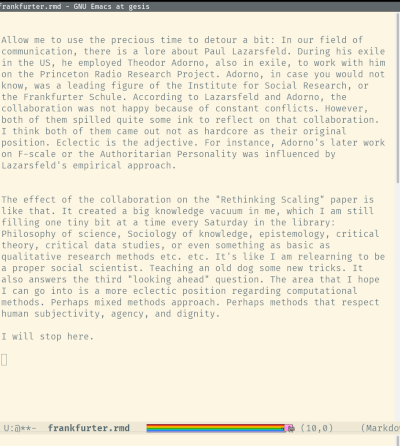
Now, I usually start my preparing with writing a script. Writing a script is great because I can write down my entire argument. In a previous blog post, I have explained the benefit of writing (especially in this so-called “AI” age.) Of course, social scientists using qualitative research methods advocate that writing helps thinking and self-reflecting. Recently, I have come to another analogy. A mathematician can certainly do the math entirely in their head. However, I would say any good mathematician would write down their proof either on a blackboard or on the back of an envelop. Again: Because writing helps thinking and self-reflecting. It should not be something that should be “outsourced” to whatever AI agents.
Writing a script also helps me to think and self-reflect about my academic presentation. First, my tone is more serious. I only want my audience to remember me being serious about my topic rather remember me being “quick witted” or whatever. Second, I am able to keep track of the word count. Word count can help me to plan the length of the talk and then a better time management. I am still collecting parameters to measure my exact presentation speed. My earliest estimation was 100 WPM, which was still too high and the wrong estimation led to overrun as I spoke slower than 100 WPM in practice. Now, I usually use 90 WPM as the rough estimate, because academic presentations usually contain long words. 1 Therefore, if the allocated time is 15 minutes, I should write a script of 90 * 15 = 1350 words. As you can see, there are not that many words. Go to the core idea directly and don’t waste time.
Only after I have a script, I would then decide whether I should have slides. In some cases, I decide not to produce slides because delivering a speech or a statement based on the script sounds enough. It is especially the case for internal presentations. However, slides could be useful sometimes for displaying definitions, tables, and figures. If I need to deliver relatively complicated presentations, I would produce slides.
With the script, producing slides is not a difficult task. In the slides, I don’t need to have things like bullet points, long sentences etc. I have mostly definitions, tables, and figures. I might write down one or two sentences at the end as the take-home message. But still, the idea is not to have wordy slides.
Then, I will practice the presentation with the script and optionally the slides. Almost always, I will need to edit both the script and the slides. In most editing cases, I edit out difficult to pronouce long words into shorter words. If some words are still difficult to pronounce (e.g., loanwords), then I will insert also the IPA in the script or listen to how Google Translate says it. It will not fix my fucking accent, but at least I have tried my best to make my presentations comprehensible for the native English speakers.
After many editing rounds, I should have a good script and maybe also slides. If I would use the slides and if I am allowed, I will also insert my script to the slides and use the presenter mode. So that I can have the script and the slides side-by-side. As a backup option, I usually also carry a printout of my script.
Actually, I will not try to memorize the script. Previously, I said that reading from a script can lead to monotonous voice. Here is the thing: Politicians read from their script. News anchors read from their prompter. Even voice actors read from their script sometimes. The cadence of a presentation is not directly related to whether one is reading from a script or from memory. But surely, practice is important to prevent a monotonous voice. Also, a script is not the speech. There must be a certain element of showmanship in the process. One might say it is acting. In German, one would say Inszenierung or Dramaturgie. As the great sociologist Erving Goffman proposed, we are basically actors in front of other people, not matter what you are presenting your scientific findings or ordering at a resturant. Somehow, one has to show one’s passion through “acting.” If one does not have that passion, of course the presentation would be flat.
I also want to add an additional benefit of writing a script: The script can be reused as a blog post. In fact, I am planning to publish some scripts on this blog for the papers that I have published and presented somewhere.
-
The average native English speaker speaks at about 150 WPM. However, when delivering a speech, one should slow down a bit. For native speakers, one should aim at around 140 WPM. However, if one wants to super clear, it can even be at around 120 WPM. Churchill, for example, spoke at this speed when he delivered his speeches. The reason why I opt for an even slower pace of 90wpm is that my English is not as clear as Churchill’s. ↩